Allergen · 5 min read · 5 October 2026

House dust mite allergy: what's happening in your bed?

Why mites live in your bed, what actually causes the allergy, how it disrupts sleep and what you can do in the bedroom.

House dust mite allergen

In short

  • 1The allergy comes less from the mite itself than from the Der p 1 protein in its droppings.
  • 2Mites are most numerous in the bed: pillows, mattress and duvet.
  • 3Allergic rhinitis disrupts every dimension of sleep; the bedroom is at the heart of the issue.

An invisible housemate

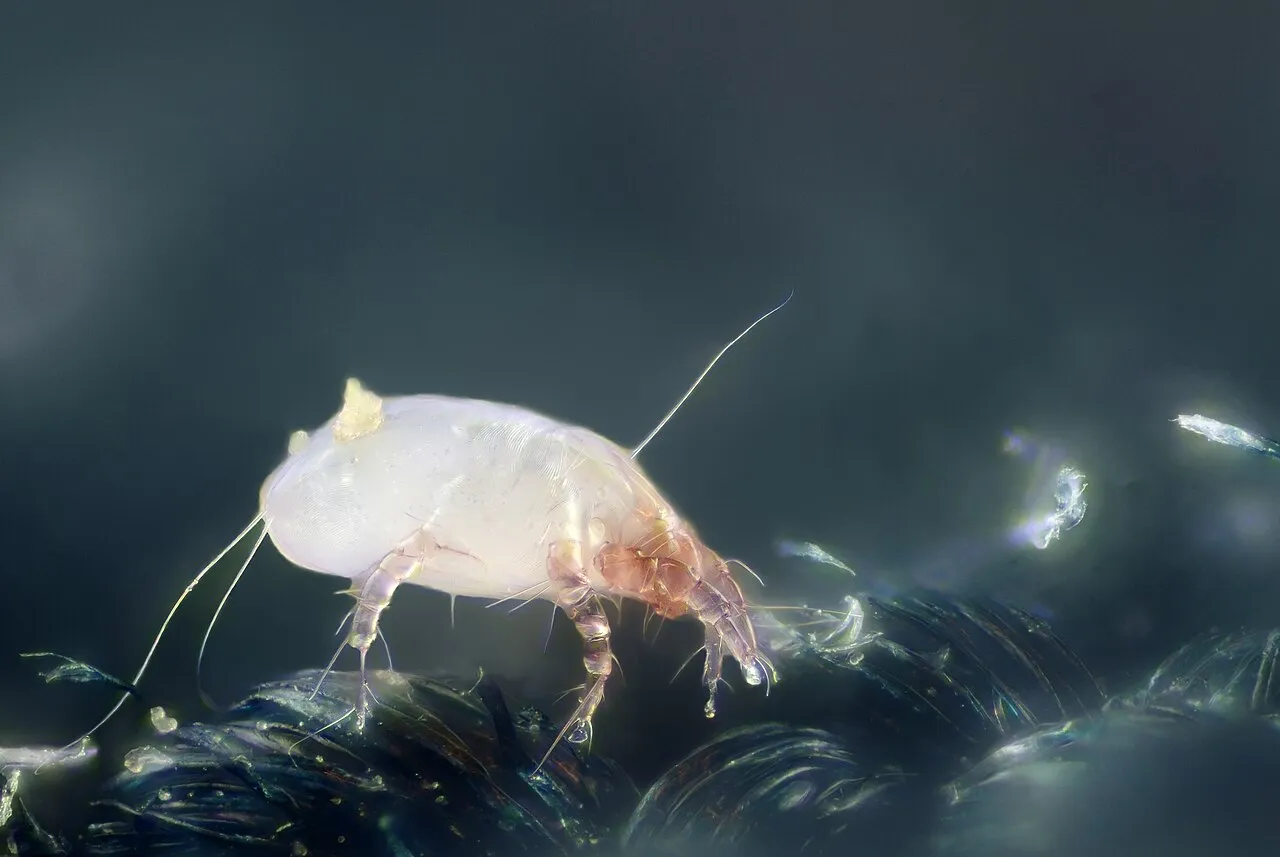
The house dust mite is an arthropod 0.2–0.3 mm long, too small to see with the naked eye. It feeds on flakes of skin shed by people and pets. It likes warm, humid conditions, which is why it lives mostly in beds, upholstered sofas and carpets.

What triggers the allergy is usually not the mite itself but proteins in its faecal pellets. The best known of these is Der p 1. The pellets are 10–40 micrometres across; when you shake out the bedding or plump up a pillow, they become airborne and mix with the air you breathe.

Why is it worse at night?

We spend an average of 7–8 hours a day on the same pillow. Mite allergen builds up right next to our faces. A study of 591 allergic rhinitis patients in France found that rhinitis disrupted every dimension of sleep; the more severe the symptoms, the worse the sleep.

Someone with a blocked nose who sneezes or coughs at night can't get into deep sleep. That's one reason for waking up tired.

What can probiotics do here?

A clinical trial in Belgium tested mattress covers impregnated with Bacillus probiotics. In the laboratory, Der p 1 on the cover fabric fell by 89%. In the 8-week trial with 20 patients, allergen levels in mattress dust fell by a similar amount with both the probiotic and the placebo covers; but those using the probiotic cover saw a marked improvement in rhinitis symptoms and quality of life.

Probiotic bacteria compete for the organic debris mites feed on, and enzymes produced by Bacillus species can break down protein-based allergens. The results are promising, but it is not a treatment on its own. That's why we say it 'helps reduce'.

What can you do in the bedroom?

The things that reduce the mite load are simple, but they need to be done regularly.

  1. 01Wash bed linen and pillowcases once a week at 60 °C; mites can't survive high heat.
  2. 02Keep bedroom humidity low, and in the morning leave the bed uncovered to air.
  3. 03Before bed, apply a probiotic spray to your pillow and bed linen from 20–30 cm away and let it dry.
  4. 04If your symptoms persist, see an allergist; adjusting your environment is no substitute for treatment.

Questions

What causes house dust mite allergy?
The allergy is mostly caused not by the mite itself but by proteins in its faecal pellets; the best known is Der p 1. The pellets become airborne and are breathed in when you shake out the bedding or plump up a pillow.
Does mite allergy affect sleep?
Yes. A study of 591 allergic rhinitis patients found that rhinitis disrupted every dimension of sleep; the more severe the symptoms, the worse the sleep.
Can I spray it on my pillow?
Yes. Before bed, spray your pillow and bedding a few times from 20-30 cm away and give it a few minutes to dry. House dust mites live mostly in the bed; washing your bedding once a week at 60 °C also reduces the mite load.
I have allergies. Will Air Biotics make them go away?
No. Air Biotics is not a medicine and does not replace allergy or asthma treatment. It is used to help reduce the allergen load in the space where you live. If your symptoms continue, talk to your doctor.
  1. 01

    Probiotics-impregnated bedding covers for house dust mite allergic rhinitis: a pilot randomized clinical trial

    Berings M, Jult F, Vermeulen H et al. (2017). Clinical & Experimental Allergy

    doi:10.1111/cea.12937

    Finding · Clinical trialIn the lab, bedding covers impregnated with Bacillus probiotics reduced the mite allergen Der p 1 in the fabric by 89%. In an 8-week trial with 20 patients allergic to mites, Der p 1 in mattress and pillow dust fell by a similar amount with both the probiotic and the placebo covers; those using the probiotic covers saw a clear improvement in rhinitis symptoms and quality of life.

  2. 02

    Allergic rhinitis and its consequences on quality of sleep: an unexplored area

    Léger D, Annesi-Maesano I, Carat F et al. (2006). Archives of Internal Medicine 166(16): 1744-1748

    doi:10.1001/archinte.166.16.1744

    Finding · Cross-sectional studyIn France, sleep was assessed in 591 patients with allergic rhinitis using validated scales. Allergic rhinitis disturbed every aspect of sleep, and the worse the symptoms, the poorer the sleep quality.

  3. 03

    Exposure to environmental microorganisms and childhood asthma

    Ege MJ, Mayer M, Normand AC et al. (2011). New England Journal of Medicine 364: 701-709

    doi:10.1056/NEJMoa1007302

    Finding · Cohort studyTwo large studies in Germany examined dust from the homes of children growing up on farms. The more diverse the microbes in the home, the lower the children's risk of asthma.

These studies were not carried out with Air Biotics. What we say about the product is limited to what is written on its packaging; Air Biotics is not a disinfectant.